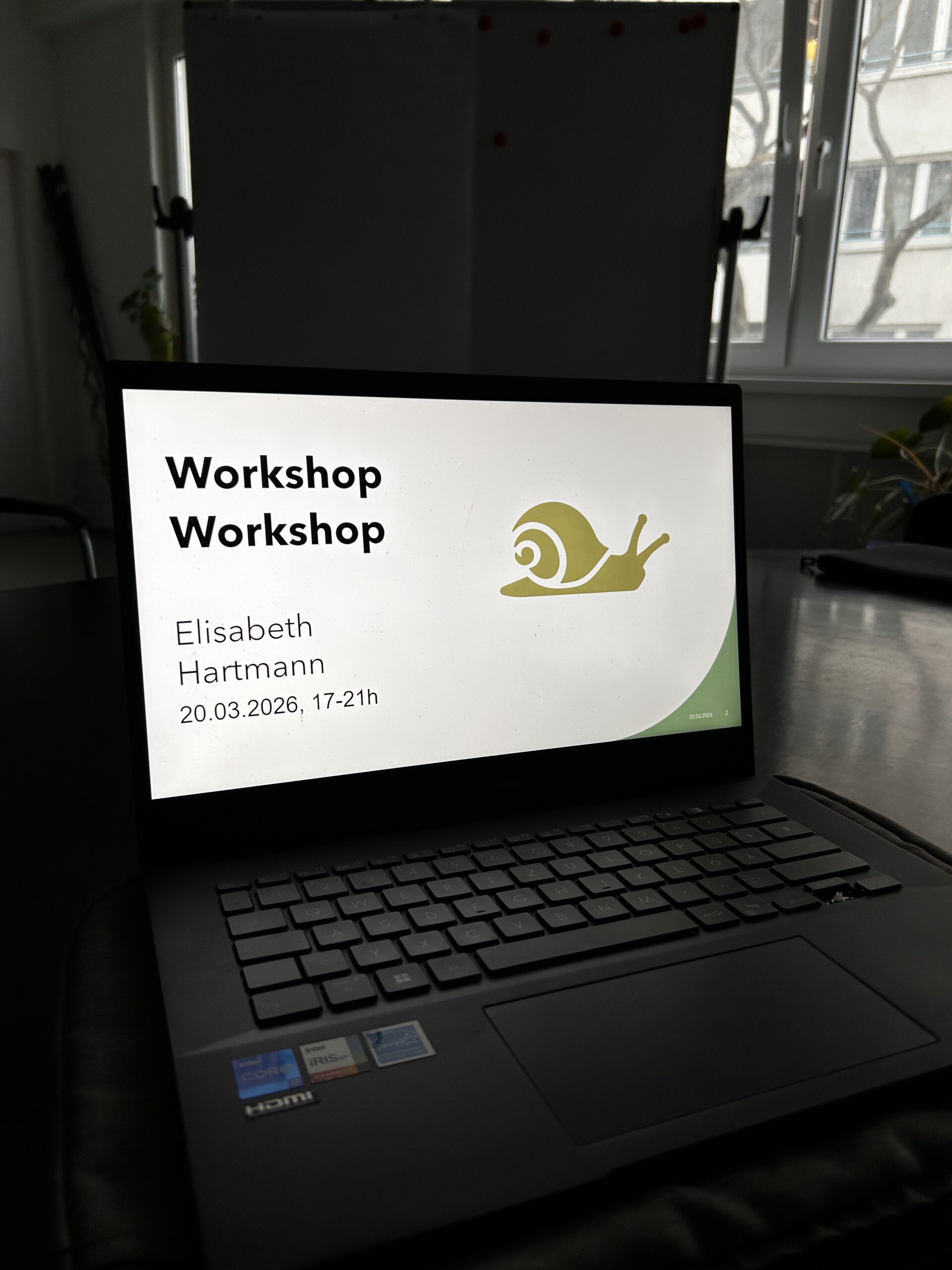
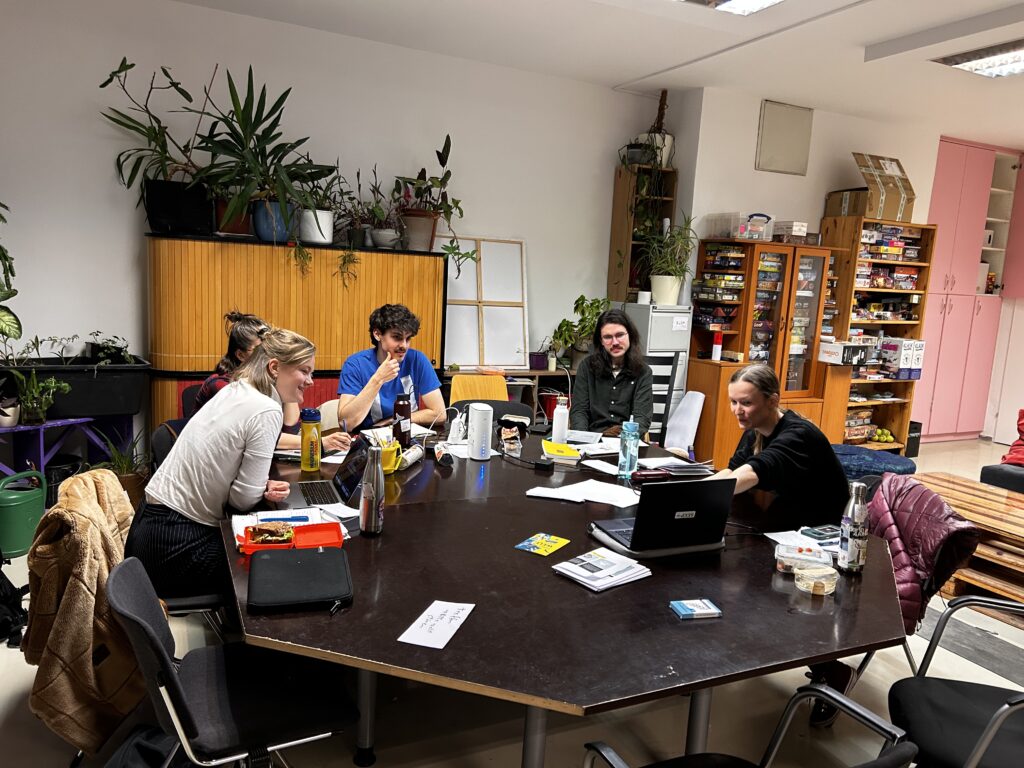
This March we did an internal skill-sharing workshop! Since Degrowth Vienna gives a lot of workshops we wanted to keep our skills sharp. So, one of our members, Elisabeth Hartmann, facilitated a methods workshop to share our insights and ideas and reflect on our ways to lead workshops.
If you’ve ever wondered how to build an interactive workshop or what transformative education is, this blog article is for you!
Let’s get started
We started out with a brain teaser on our values and passions connected to degrowth. It reminded all of us why we are active with Degrowth Vienna and got us into the right headspace.
As this was an internal workshop we had a lot of experienced workshop leaders in the group but also some newer members that had never led a workshop on their own. This meant the expectations differed a lot: Some people wanted to learn some workshop methods and gain the confidence to give their first workshop. Others had more specific ideas such as how to make a workshop different from all the others you have already participated in and how to manage difficult situations.
Position Barometer
To get moving after the introduction rounds we started a position barometer. This means everybody answers a specific question by positioning themselves along a defined line in the room, e.g. between agreement and disagreement. This was a great exercise to see different opinions existing in the same space, but it makes people reflect on their position and take a stand. While we liked the fact that it forces people to decide on an answer to the question, it was important to us that everybody could change that position if e.g. another person’s justification convinced them otherwise.
Our position barometer was especially interesting because our workshop facilitator chose highly interesting and controversial questions that provoked different opinions even in our relatively homogeneous group. One example was:
What is more important: Competences for action or reflecting on existing struggles and values?
In this case it was especially hard as we had to choose one or the other exclusively and it split our group in half. What would you choose?
Afterwards we reflected on the method and agreed that it was very useful but worked especially well in our smaller group. In bigger groups not everybody will be able to justify their position due to time constraints. So you can separate the participants into groups of two (“think pair shares”) so that everybody gets to talk about their opinion. These pairs can then also come together with another pair and so on in a 2-4-8-16 fashion before the groups share with the plenary. To make sure that people remember their opinion after they have heard another person speak, have them write down their opinion on a piece of paper before sharing.
Foundational Thinkers
“We usually assume that education isn’t the problem, but rather a lack
of education. That the more education a person has received, the
greater their contribution to the environment and justice.
Why, then, are the greatest socio-ecological ills attributed to people
with BAs, MAs and PhDs?
We do not just need more education. We need an education that
goes to the heart of the matter.”
(Orr 2004)
This quote shows that more education is not always the solution, but it is rather the kind of education that matters. Based on this attitude Elisabeth presented us with the concepts of education for sustainable development (ESD) and transformative education/learning.
Two thinkers made very important contributions to these concepts: Paulo Freire and bell hooks.
Paulo Freire (1921-1997) was a Brazilian pedagogue, philosopher and historian who pioneered the Pedagogy of the Oppressed. He thought that ‘regular’ education served mostly to uphold the status quo. According to him current education followed a banker’s concept: Putting knowledge into heads to be withdrawn when it is needed. However, he also firmly believed that education could be part of liberation if it was critical, dialogue- and practice-oriented (practice = reflection on the world and action in/on the world). In the Pedagogy of the Oppressed, education should consider learners’ everyday lives and reflect on power and dominance structures.
The US-American teacher, author and intersectional feminist bell hooks (1952-2021) built on Freire’s work. Her concept of Teaching to Transgress has 5 central pillars:
- Engaged pedagogy: Education as the practice of freedom with intellectual rigor and, importantly, emotional engagement.
- Spaces of possibility: The classroom should be a space where everybody can be fully present and explore new ideas. Sadly, this potential isn’t always fulfilled.
- Love as the central force: Caring for the students’ intellectual and spiritual growth. This is a needs-based approach, meaning the teachers adjust to the needs of the students and create as safe a space as possible.
- Challenging the banking model: This builds on Freire and considers learning as an active process.
- Tool for liberation: Education is not merely skill acquisition but can be a transformative tool.
With this knowledge in mind, we again reflected on our values and passions connected to degrowth and how this could shape us as teachers and/or workshop facilitators. Since nobody can turn off their values and biases we should be aware of them and build our teacher/facilitator personality around it. Ambiguity tolerance is an important skill for students and teachers alike as e.g. not everybody will like degrowth.
Education for Sustainable Development (ESD)
ESD is the combination of environmental education and global learning. It explicitly aims at achieveing the UN Sustainable Development Goals (SDGs). Pedagogically it is discourse-oriented and centers self-reflection and controversy (for more background see Beutelsbacher Konsens). It tries to bring together reflection and action to give people shaping competence (Gestaltungskompetenz).
There are three kinds of ESD[i]. While ESD1 focusses more on competences for action, ESD2 centers reflection of values and deconstructing expert knowledge. ESD3 can also be called transformative education or learning.
Transformative education is based on the pedagogies of Freire and hooks. It aims at a profound shift in underlying values and assumptions. However, it is open when it comes to learning outcomes. Rather, it focuses on the learning process, making alternatives visible and empowering people to use the tools they have. On the one hand it criticizes ESD1 as being to instrumentalizing and centers reflection. On the other hand it is not as constructivist as ESD2. It acknowledges that we have to address the current crises and focuses on learning in relation to a changing world. Furthermore, transformative education has a different relationship to the non-human world than both ESD1 and 2.
However, Konzeptwerk Neue Ökonomie in Germany is the only organization we know of actively practicing transformative education.
Group Work
For the last hour of the workshop, we split into groups to reflect on our new knowledge and collaborate on a topic of our choice. One group focused on the stages and preparation of a workshop and sharing experiences and insights with the new people. The other group focused on methods that can help facilitate a workshop where the participants have very different starting knowledge levels.
Finally, the workshop workshop ended after another short reflection and a feedback round of:
I liked…
I wished…
I learned…
Conclusion
We had a wonderful workshop workshop that brought us closer together as a team! The more experienced people got to reflect on their teacher/facilitator personality and the newer members learned a lot about how to lead a workshop.
Since I am relatively new to facilitating workshops, I learned a lot. Thank you Elisabeth for showing me how it’s done right! If you are wondering how to prepare and lead a workshop this is a great blueprint. This workshop was very entertaining and informative at the same time. It took four hours and yet none of us got bored for even a second!
The most important thing I learned though is: Take enough breaks! Noone can pay attention without having time to recharge.
Let us know if you’re interested in such a workshop for the public!
[i] Pettig, F., & Singer-Brodowski, M. (2024). Learning in Relation with a Changing World: Thinking Beyond ESD 1 and ESD 2 Towards ESD 3. Journal of Education for Sustainable Development, 18(2), 176-201.